

University success is an energy allocation problem rather than a raw effort contest. Break your semester into four distinct phases: balance challenging and lighter courses, choose the right professors, dissect the syllabus on day one to prioritize high-yield assignments, and begin exam preparation four weeks early. Pacing yourself thoughtfully makes college life remarkably manageable.
When I first entered university, I assumed that simply attending every lecture and taking diligent notes would automatically yield top grades. But after a few semesters, I realized that university is fundamentally an optimization puzzle. Those who pace their energy and plan their strategy early maintain a high GPA while enjoying ample time for outside pursuits; those who study blindly without strategy burn out fast.
Here are the four strategic phases I follow to navigate every semester smoothly:
1. Master the Academic Roadmap Before Course Registration
Don't wait until the registration portal opens to scramble and figure out what classes to take. The very first step every student should take is downloading their department's complete curriculum handbook to map out all required credits across the degree program.
With the big picture in view, my golden rule is: take at most three demanding major courses per semester, paired with three lighter electives and one or two general education courses to protect your GPA. Above all, never stack three or four calculation-heavy courses in the same semester unless you want an unbearable workload. Consult student forums or senior students directly to find out which classes are rigorous and which are manageable.
Reference website: School of Business, International University - VNU
2. Registration Tactics and Choosing the Right Professors
Students often joke that course registration is a 'lottery of luck.' But even luck requires diligent preparation. Prior to registration day, compile a ranked list of professors whose teaching styles match your preferences or who come highly reviewed. Every instructor possesses a distinct delivery style and grading philosophy. Picking the right instructor secures 50% of your engagement for the entire course.
What if the network lags and you miss your preferred section? Don't panic:
- Watch the add-drop week: Students shuffle classes constantly during this week, and vacant spots open unexpectedly.
- Register for Teaching Assistant (TA) tutorial sections: A fantastic lifeline when main lecture sections reach capacity.
- Audit lectures: If your assigned section feels uninspiring, you can sit in on lectures with captivating professors who grade projects fairly.
Learning with inspiring teachers makes group projects and lecture comprehension far more rewarding.
3. Decode the Course on Day One
The introductory class is the most valuable session of the entire semester—never skip it. In higher education research, Slattery & Carlson (2005) emphasize that the course syllabus acts as a 'learning contract' establishing the rules of engagement between faculty and students.
This is when professors walk through the syllabus and clarify the rules: grade weightings, whether they prioritize analytical depth or presentation polish, and specific project guidelines. At my university, a typical breakdown looks like:
- Project: 30%
- Midterm Exam: 30%
- Final Exam: 40%
Once you know these exact weights, you know precisely where to invest 100% of your effort and where you can deliver standard performance to preserve your energy safely.
4. Review 4 Weeks Ahead to Never Pull an All-Nighter
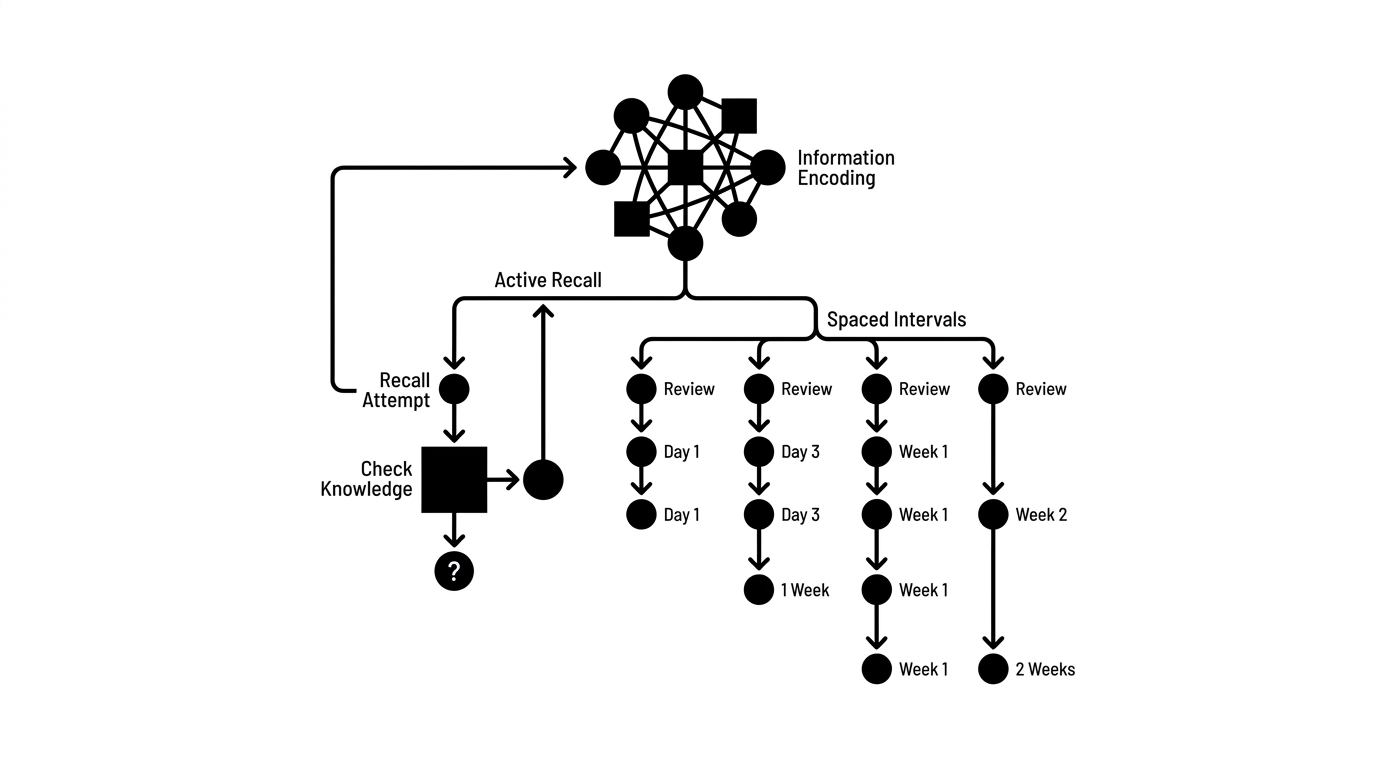
I maintain an unbreakable rule: always begin exam preparation four weeks in advance. In cognitive science, this is known as Distributed or Spaced Practice, researched by Cepeda et al. (2006) and classified by Dunlosky et al. (2013) as one of the highest utility learning techniques. Four weeks may sound early, but it actually means spending only a modest amount of time each day reinforcing memory traces, completely eliminating the exhaustion of last-minute cramming.
Before diving into studying, clarify the exam format directly with your professor:
- Is the exam open-book or closed-book?
- What is the ratio between multiple-choice and essay questions?
- Which chapters carry the highest weight, and are sample problems available?
Knowing the exam format is like having a precise map. You focus only on what genuinely matters on the test rather than drowning helplessly in a multi-hundred-page textbook.
University is not about struggling endlessly; it is about pacing yourself and mastering your energy. Wishing you a smooth and successful semester!
References
- Cepeda, N. J., Pashler, H., Vul, E., Wixted, J. T., & Rohrer, D. (2006). Distributed practice in verbal recall tasks: A review and quantitative synthesis. Psychological Bulletin, 132(3), 354-380. (The Spaced Practice effect).
- Dunlosky, J., Rawson, K. A., Marsh, E. J., Nathan, M. J., & Willingham, D. T. (2013). Improving Students' Learning With Effective Learning Techniques: Promising Directions From Cognitive and Educational Psychology. Psychological Science in the Public Interest, 14(1), 4-58.
- Slattery, J. M., & Carlson, J. F. (2005). Preparing an Effective Syllabus: Current Best Practices. College Teaching, 53(4), 159-164. (Decoding the syllabus as an instructional contract).
- School of Business, International University (HCMIU - VNU). Bachelor of Business Administration Curriculum Framework. hcmiu.edu.vn.