

Going to class isn't about sitting there just to mark attendance and then reopening textbooks at home to relearn everything from scratch. The highest value of a lecture lies in what the professor shares beyond the textbook and the exam hints revealed in real-world contexts. When you prepare properly the night before, you walk into class to validate your understanding rather than drown in a sea of new information.
Almost every university student has lived through this: spending three hours in a lecture hall in the morning, staring at slides, listening to the professor, yet feeling completely blank. Coming home in the afternoon and opening your notebook, everything has evaporated, forcing you to grind from scratch all over again.
After switching between laptop typing and iPad note-taking, I realized: the more I leaned on high-tech devices, the faster knowledge slipped away. The most effective study routine actually boils down to three clear phases:
graph TD
    A["1. The Night Before: Preparation"] --> A1["NotebookLM summarizes slides"]
    A --> A2["Pre-testing effect quiz"]
    A --> A3["Distill onto 1 sheet of A4 paper"]

    B["2. In Class: Capturing Signals"] --> B1["Sit in the front row for focus"]
    B --> B2["Record only real-world examples & exam hints"]
    B --> B3["Do not copy slides"]

    C["3. At Night: The Feynman Technique"] --> C1["Flip the A4 sheet over & explain aloud"]
    C --> C2["Review sections where you hesitated"]
    C --> C3["Spaced review at 1, 3, and 7 days"]

    A3 --> B
    B3 --> C
1. The Night Before: Priming Your Brain with Pre-Testing
The objective of evening preparation is not memorizing the entire lecture, but anchoring a mental framework in your brain:
- Summarize and decode: I open NotebookLM, upload all the next day's lecture slides to generate a mind map and overview of the main arguments. Whenever I encounter confusing concepts, I prompt ChatGPT to explain them using the simplest possible language.
- Pre-testing effect: I ask NotebookLM to generate a short multiple-choice quiz on the lecture material to test myself immediately. The human brain only becomes truly receptive to learning when it actively tries to retrieve an answer and makes an error. Walking into class the next morning, you are actively hunting for the answers to the questions you got wrong the night before.
- The single A4 sheet: All key concepts and unresolved questions are condensed onto exactly one physical sheet of A4 paper. Handwriting forces your fingers and brain to synthesize information rather than mindlessly copy-pasting. Just 15 minutes before class, skimming that single page primes your brain to get into the zone immediately.
2. In Class: Capturing What Textbooks and AI Cannot Provide
Because the foundational framework was set the night before, I never copy slide content during lectures. The only notes added to my A4 sheet are high-leverage insights:
- Real-world examples and focal points: How professors emphasize particular concepts, case studies drawn from their industry experience, and subtle hints regarding the exam structure. These are nuances you can only catch by being present.
- Front row advantage: Sitting in the front row shields you from smartphone distractions, makes asking questions effortless, and earns valuable participation bonus points.
- Two non-negotiable lectures: The very first introductory lecture and the final review session before finals should never be missed. That is when professors reveal the critical roadmap and exam boundaries for the entire semester.
3. At Night: The Feynman Technique and Spaced Repetition
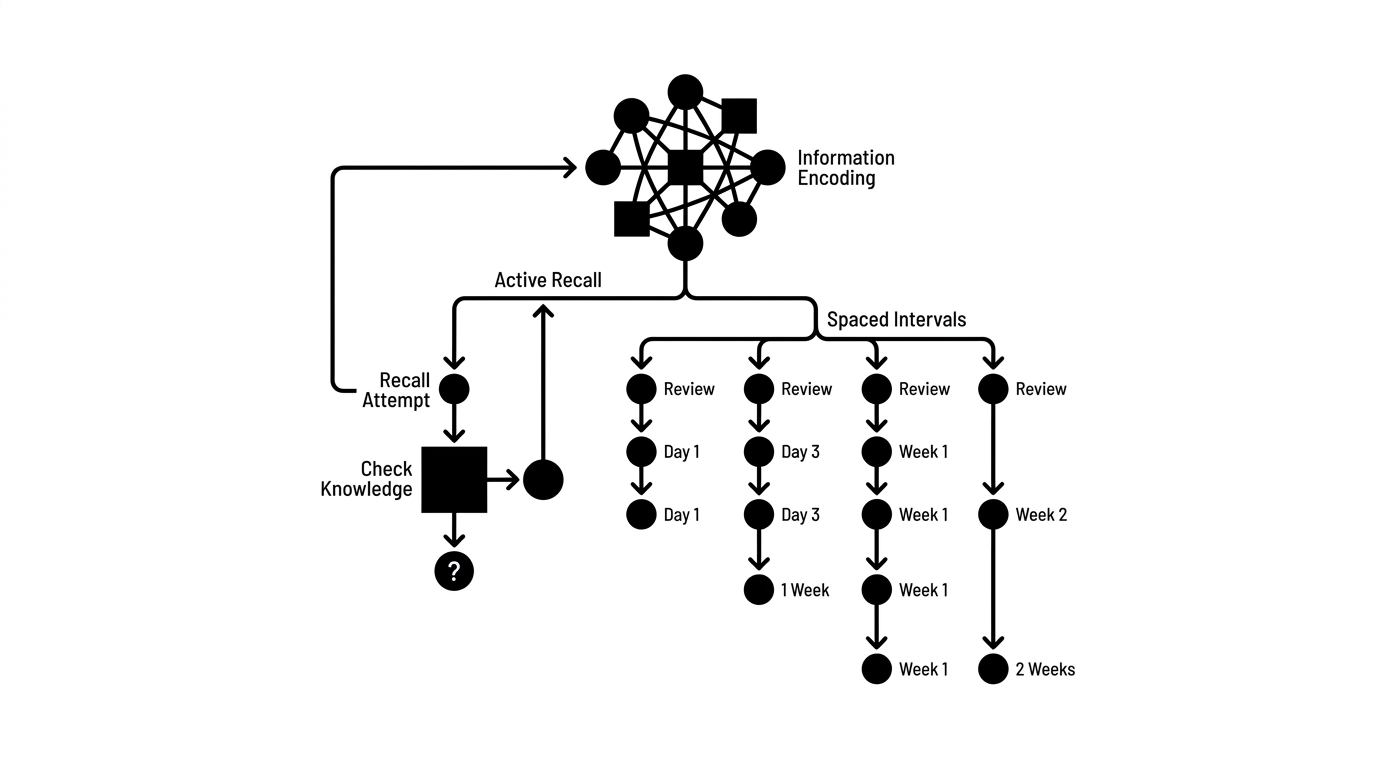
The brain falls down the forgetting curve rapidly if you only review notes passively. To make the knowledge truly your own, I use two steps:
- The Feynman Technique: Turn the A4 sheet facedown and explain the core concept aloud in plain, conversational language, as if teaching someone with zero background. Any point where you stumble or hesitate indicates an actual knowledge gap - and only then do you flip the sheet over to review that specific spot.
- Spaced Repetition: The following evening, three days later, and one week later, I pull out the NotebookLM quiz questions to test recall once more, distributing the retention cycle without needing last-minute all-nighters.
Everything revolves around one core principle: the brain retains knowledge deeply only when forced to actively process and retrieve information. One sheet of A4 forces selective synthesis, a pre-class quiz triggers curiosity, and self-explanation demands genuine mastery.
When you shift your posture from a passive listener to an active hunter of answers, studying becomes substantially lighter and far more rewarding.
References
- Mueller, P. A., & Oppenheimer, D. M. (2014). The pen is mightier than the keyboard: Advantages of longhand over laptop note taking. Psychological Science, 25(6), 1159-1168. (Handwriting forces deeper cognitive processing and synthesis compared to verbatim typing).
- Kornell, N., Hays, M. J., & Bjork, R. A. (2009). Unsuccessful retrieval attempts enhance subsequent learning. Journal of Experimental Psychology: Learning, Memory, and Cognition, 35(4), 989-998. (The Pre-testing Effect: Attempting tests prior to learning activates attentional networks).
- Ebbinghaus, H. (1885). Über das Gedächtnis: Untersuchungen zur experimentellen Psychologie. Duncker & Humblot. (The forgetting curve and the decay rate of memory over time).
- Cepeda, N. J., Pashler, H., Vul, E., Wixted, J. T., & Rohrer, D. (2006). Distributed practice in verbal recall tasks: A review and quantitative synthesis. Psychological Bulletin, 132(3), 354-380. (Spaced Repetition mechanisms for consolidating long-term retention).
- Roediger, H. L., & Karpicke, J. D. (2006). Test-enhanced learning: Taking memory tests improves long-term retention. Psychological Science, 17(3), 249-255. (The Testing Effect: Active retrieval practice vastly outperforms passive re-reading).
- Gleick, J. (1992). Genius: The Life and Science of Richard Feynman. Pantheon Books. (The Feynman Technique: Gauging genuine comprehension through simplified explanation).