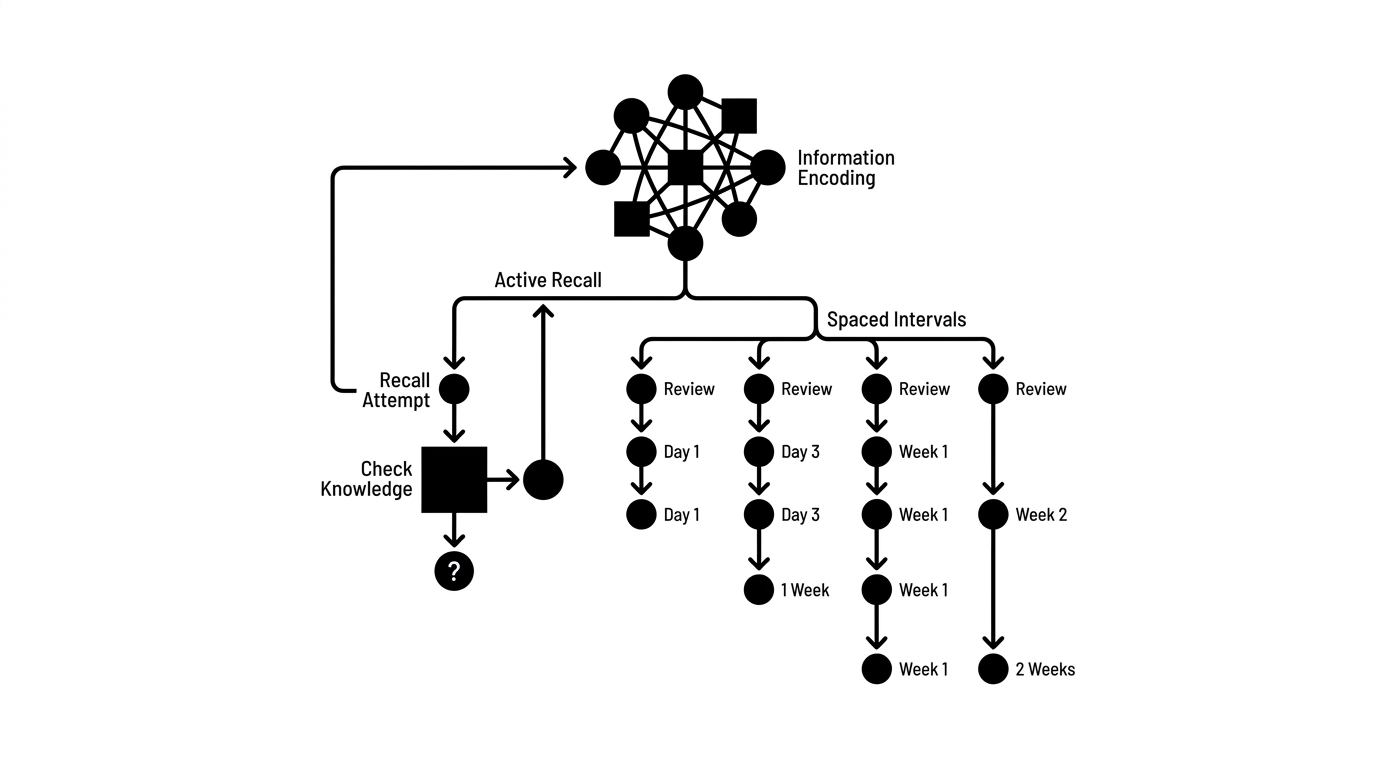

Most of us grew up believing that re-reading notes and highlighting textbooks is the best way to study, but massive research across 169,000+ learners proves these are actually the least effective techniques. Your brain only locks in knowledge when you force it to retrieve information, not when you passively recognize familiar text on a page.
Growing up in Vietnam, the default study advice was simple: memorize everything by heart. Everyone told me to read my notes again and again until they stuck.
I spent countless late nights re-reading textbook chapters five or six times, covering every page in bright yellow highlighter. Looking down at the open book, everything felt easy and familiar. My mind tricked me into believing I had mastered the entire chapter. Yet the moment I closed the book or walked into the exam room, my mind went completely blank.
It was only when I watched Ali Abdaal's video "How I Ranked 1st at Cambridge University - 20 Study Tips" that I had my wake-up call. Ali argued that passive note-taking and re-reading were largely a waste of time, urging students to switch to Active Recall instead. Digging deeper into cognitive science, I discovered what psychologists call the "illusion of competence." Visual familiarity tricks your brain into confusing easy recognition with true memory retrieval. Your eyes recognize the words, but your brain never formed the neural pathways to retrieve them independently.
While no single method fits every subject, empirical research provides an objective ranking of what actually works.
The Hierarchy of Common Study Methods
In 2013, Professor John Dunlosky and his team systematically reviewed 10 popular learning techniques. In 2021, researchers Gregory Donoghue and John Hattie conducted a massive meta-analysis analyzing 242 studies across 169,000+ learners ("A Meta-Analysis of Ten Learning Techniques"), confirming the relative efficacy of these strategies:
| Tier | Study Method | Core Biological Mechanism | Practical Everyday Example |
|---|---|---|---|
| Tier 1: The Gold Standard (Highest Impact) | Practice Testing (Active Recall) | Forces your brain to retrieve and reconstruct knowledge from memory without cues. | Close your book and write down everything you remember on a blank sheet, or solve practice problems without notes. |
| Distributed Practice (Spaced Repetition) | Spreads review sessions across expanding time intervals to interrupt natural decay. | Study 45 minutes a day across 5 consecutive days rather than cramming 5 hours the night before. | |
| Tier 2: Comprehension Accelerators (Moderate Impact) | Elaborative Interrogation | Prompts your brain with "Why is this fact true?" to uncover root causes. | Instead of memorizing a revenue formula, explain why a price reduction alters operating margins. |
| Self-Explanation (Feynman Technique) | Explains complex concepts in simple, everyday words as if teaching a beginner. | Use a whiteboard to explain inflation using simple grocery basket prices. | |
| Interleaved Practice | Alternates between different problem types within one session instead of blocked drills. | Practice 1 probability problem, 1 geometry problem, and 1 algebra problem in rotation rather than 20 identical drills. | |
| Dual Coding | Combines verbal channels with spatial visual diagrams to double retrieval routes. | Sketch a clean flowchart of an order processing workflow next to your bullet notes. | |
| Tier 3: The Illusion Traps (Lowest Impact) | Highlighting & Underlining | Colors words without engaging analytical thinking or active retrieval effort. | Highlighting half a page yellow while struggling to summarize its core thesis from memory. |
| Re-reading | Passively scanning notes creates false fluency without building recall stamina. | Reading through a slide deck for the fourth time without self-testing whether you can explain it aloud. | |
| Verbatim Summarization | Mindlessly copying text from books into notes without synthesis. | Typing lecture transcripts word-for-word into Notion during class. |
A Simple 3-Step Daily Study Routine
You do not need to overhaul your entire life overnight. Start with this straightforward routine:
- Scan the skeleton first: Skim the text once to understand the structural hierarchy. Limit underlining to at most 1 or 2 key words per page. Never highlight full sentences.
- Close the book and test recall: After finishing a section, close the book. Take a scrap paper and write down 3 key takeaways from memory, or write 2 questions you will test yourself on tomorrow.
- Space it out: Schedule a reminder on your calendar to answer those two questions 48 hours later.
What Lies Ahead
This post serves as a high-level map to separate proven mechanics from deceptive study habits.
In upcoming posts, I will break down each method in depth: from building a zero-friction Active Recall setup with paper and flashcards, to using modern spaced repetition algorithms and turning AI into an interactive drill partner.
References & Further Reading
- Dunlosky, J., Rawson, K. A., Marsh, E. J., Nathan, M. J., & Willingham, D. T. (2013). Improving Students' Learning With Effective Learning Techniques: Promising Directions From Cognitive and Educational Psychology. Psychological Science in the Public Interest, 14(1), 4-58.
- Donoghue, G. M., & Hattie, J. A. C. (2021). A Meta-Analysis of Ten Learning Techniques. Frontiers in Education, 6, 607590. (Meta-analysis of 242 studies and 169,000+ learners).
- Ali Abdaal. (2018). How I Ranked 1st at Cambridge University - 20 Study Tips. Watch on YouTube.