

When you ask an AI and receive a lengthy bulleted list, everything seems crystal clear while reading - yet ten minutes after closing your laptop, nothing remains. That is the trap of funneling all information through a single verbal channel. By activating Dual Coding, you open a parallel spatial processing channel, helping your brain retain knowledge twice as long with zero extra effort.
I use AI tools like ChatGPT and Claude almost every day. At first, I assumed that simply feeding documents to AI to generate concise summaries or bulleted lists would allow me to learn multiple times faster.
But after a few months, I ran into a frustrating roadblock: while my eyes were scanning lines of AI-generated text, everything felt logical, eloquent, and compelling. Yet the moment I closed my screen or had someone ask me about it the next day, I could barely recall or articulate the core essence of the topic.
In cognitive psychology, this phenomenon is known as the 'Illusion of Competence.' When reading a wall of text, the brain merely skims the semantic surface without actually constructing a mental model in your mind.
Searching for a way to learn both fast and deep, I stumbled upon Dual Coding Theory. This proved to be the key that completely transformed how I absorb and retain information.
graph TD
    classDef box fill:#18181b,stroke:#3f3f46,stroke-width:1.5px,color:#fafafa;

    A["Data from AI & Technical Docs"] --> B{"Cognitive Routing"}

    B -->|"Verbal Channel"| C["Words & Sequential Logic"]
    B -->|"Visual/Spatial Channel"| D["Diagrams, Boxes & Relationships"]

    C --> E["Referential Processing"]
    D --> E

    E --> F["Dual Memory Trace"]
    F --> G["Dual Retrieval Activation & Superior Recall"]

    class A,B,C,D,E,F,G box;
1. The Scientific Foundation: The Bottleneck of the Verbal Channel
Cognitive psychologist Allan Paivio demonstrated that the human brain processes information through two separate, parallel cognitive subsystems:
- Verbal Channel: Takes in text, spoken words, and sequential word-by-word logic.
- Visual/Spatial Channel: Takes in shapes, spatial distances, hierarchical structures, and relational positioning between elements.
The primary flaw with reading plain text alone (especially long-winded AI responses) is that you overload 100% of the cognitive burden onto the verbal channel. The Working Memory capacity of this channel is remarkably limited. According to research by Nelson Cowan (2001), the working memory holds at most about four information chunks at a time. By the time you read the fifth bullet point, new information immediately pushes earlier ideas out.
However, when you complement text with a visual diagram, the brain activates Referential Processing. The visual channel leverages preattentive visual processing to grasp the overall spatial layout almost instantly, freeing the verbal channel to focus deeply on the semantic meaning of each concept.
Both hemispheres connect cross-referentially, establishing a Dual Memory Trace. Later, when you need to recall the material, even if the exact phrasing escapes you, the spatial imagery of the diagram automatically brings the verbal memory back to the surface.
2. Compelling Empirical Research
The power of Dual Coding is not subjective intuition; it has been validated across numerous neuroscience and educational studies:
- Up to 65% retention after 72 hours: Research on the Picture Superiority Effect synthesized by neurobiologist John Medina (2008) reveals that humans retain only about 10% of text-only information after 72 hours, whereas this number surges to 65% when content is accompanied by visual imagery and structured diagrams. This directly corroborates Allan Paivio's Dual Coding Theory (1971, 1986).
- Exceptional learning gains (d = 0.85): A meta-analysis by Paul Ginns (2006) spanning over 50 empirical studies on the Spatial Contiguity Effect recorded a massive educational effect size (d = 0.85 for complex material) when verbal labels are integrated directly into diagrams, eliminating Split-Attention compared to reading disjointed captions placed away from figures.
- Eliminating Cognitive Overload: Richard Mayer (2001, 2009) in his Cognitive Theory of Multimedia Learning proved that distributing information across both visual and auditory/verbal channels substantially reduces Extraneous Cognitive Load, freeing working memory capacity for deep, generative processing.
3. How I Prompt AI to Output Visuals for Instant Recall
Ever since discovering this principle, I never let ChatGPT or Claude respond with plain paragraphs alone. Here are the three prompts and daily habits I rely on:
┌────────────────────────────────────────────────────────────────────────┐
│               3 STEPS TO PRACTICE DUAL CODING WITH AI                  │
└───────────────────────────────────┬────────────────────────────────────┘
                                    │
    [ 1. Request Mermaid Diagrams ]─┼──> Turn abstract logic into boxes & arrows
                                    │
                                    ▼
    [ 2. Force Matrix Tables ]──────┼──> Turn comparative text into a 2D matrix
                                    │
                                    ▼
[ 3. Active Hand Drawing ]──────┼──> Close your screen, sketch from memory- Always request flowcharts: Whenever exploring a process, working mechanism, or system architecture, I append this prompt: 'Please draw a Mermaid diagram or ASCII box diagram clearly showing: Inputs -> Processing Steps -> Outputs.' A diagram with a few boxes and directional arrows allows your eyes to take in the complete landscape in seconds.
- Convert comparison text into matrix tables: Rather than wading through three dense paragraphs comparing similarities and differences, I ask: 'Create a 2D comparison table with four core criteria: Definition, Mechanism, Advantages, and Limitations.' Tables are the simplest and most effective form of spatial visualization.
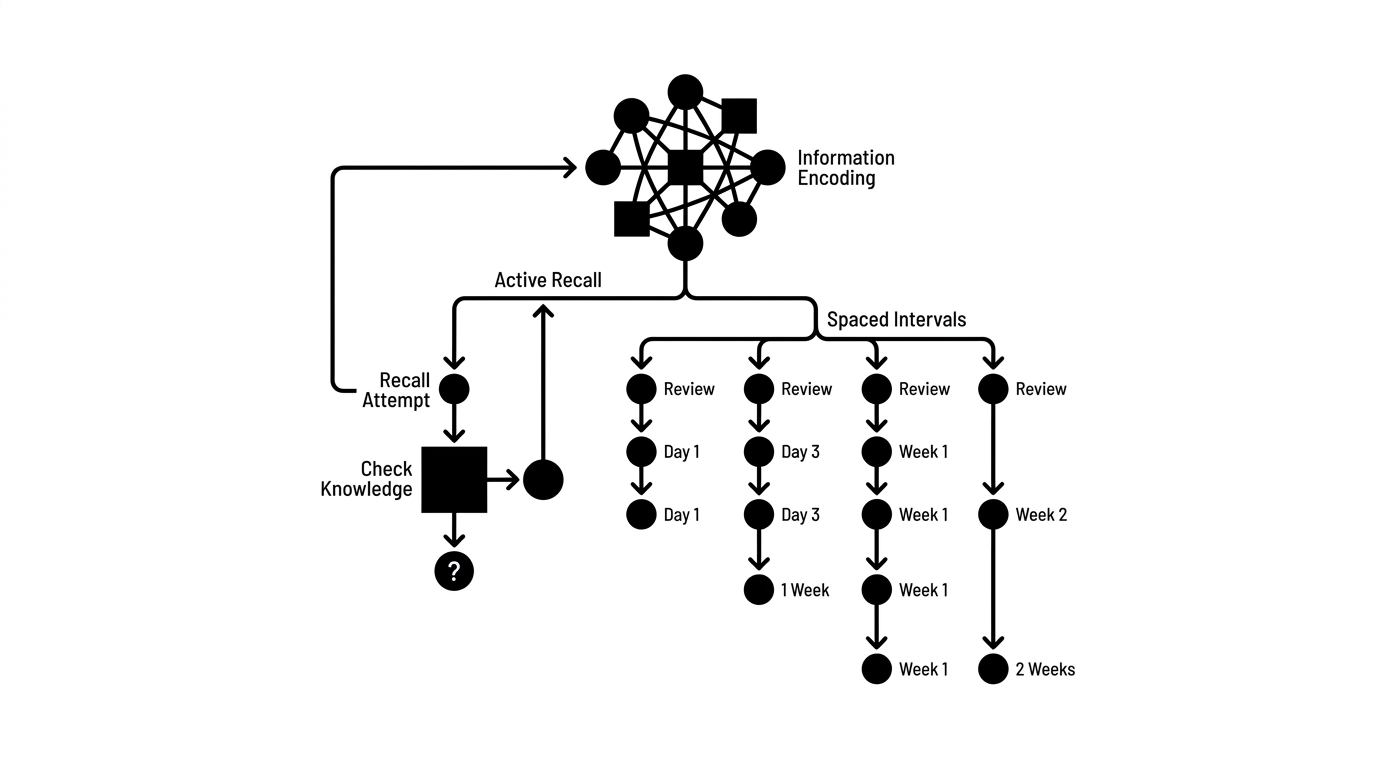
- Active Retrieval sketching: This is the most crucial step to lock knowledge into long-term memory. After reviewing the AI-generated diagram, I turn off my computer screen, grab a piece of scrap paper or open my iPad, and redraw the diagram entirely from memory. Once you can independently reproduce the structure and flow of arrows, that knowledge truly belongs to you.
AI can generate an ocean of words in a matter of seconds. But if more words leave nothing behind in your head, reading endlessly is wasted effort.
Fast learning isn't about rushing through every bullet point. It's about turning flat text into vivid spatial diagrams, so knowledge doesn't just skim past your eyes - it takes deep root in your thinking.
References
- Paivio, A. (1971, 1986). Mental representations: A dual coding approach. Oxford University Press.
- Paivio, A., & Lambert, W. E. (1981). Dual coding and bilingual memory. Journal of Verbal Learning and Verbal Behavior, 20(5), 532-539.
- Medina, J. (2008). Brain Rules: 12 Principles for Surviving and Thriving at Work, Home, and School. Pear Press. (Chapter 10: Vision).
- Ginns, P. (2006). Integrating information: A meta-analysis of the spatial contiguity and temporal contiguity effects. Learning and Instruction, 16(6), 511-525.
- Mayer, R. E. (2001, 2009, 2021). Multimedia Learning. Cambridge University Press.
- Cowan, N. (2001). The magical number 4 in short-term memory: A reconsideration of mental storage capacity. Behavioral and Brain Sciences, 24(1), 87-114.