
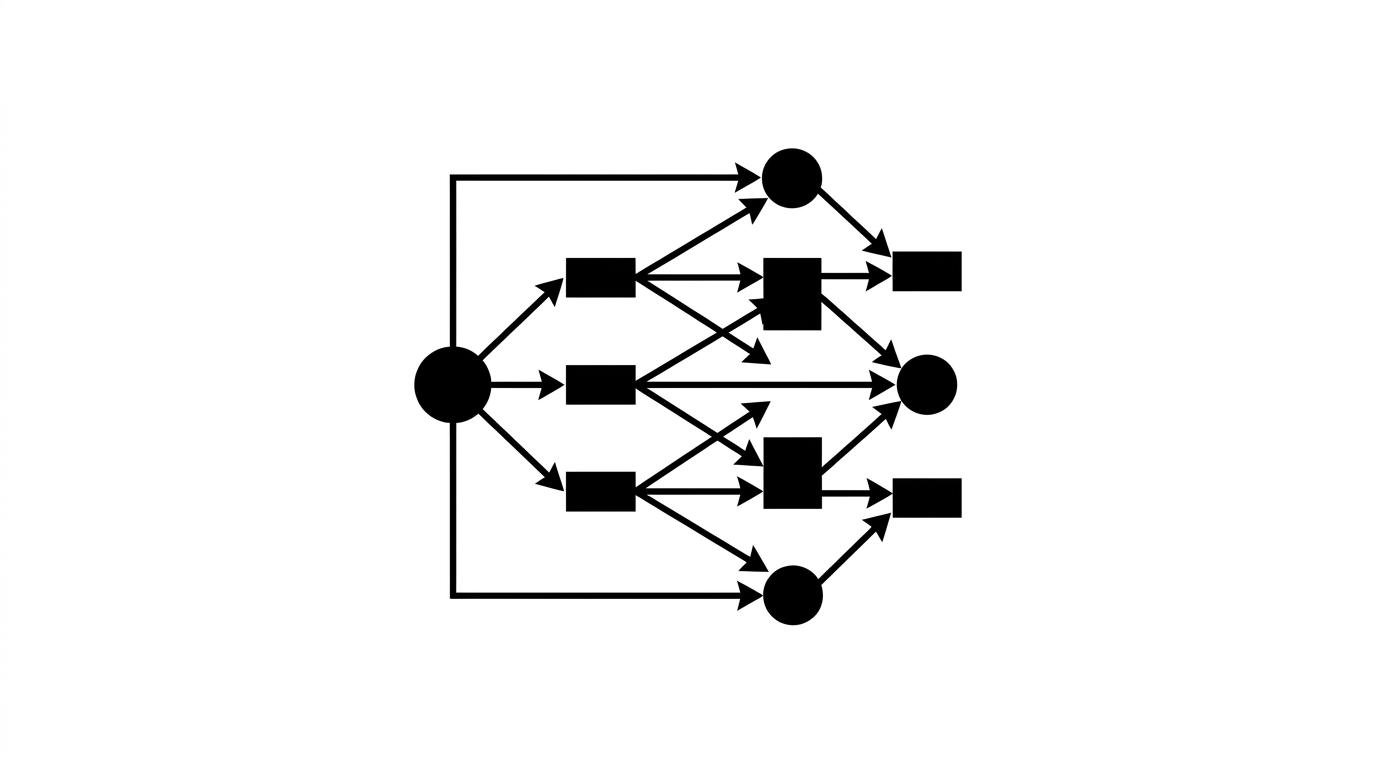
Deploying AI agents into real-world production cannot rely on open-ended while-loops, which quickly drift, loop indefinitely, and burn runaway tokens. Graph Engineering solves this instability by structuring AI workflows like an organizational chart: isolating specialized tasks into discrete nodes, passing a typed shared state, and governing execution through explicit control-flow patterns (Fan-out, Join, and Router).
When developers first build AI agents, the journey almost always follows the same progression: start with a massive prompt, then wrap the agent in an autonomous feedback loop (a while-loop) so it can plan, act, observe, and correct its own mistakes.
This approach (known as Loop Engineering) works well for rapid prototyping and open-ended coding spikes. But in complex enterprise workflows where deterministic reliability is non-negotiable, open loops quickly break down: agents drift off-task, hallucinate recursive errors, and drain API budgets in minutes.
In their video "Graph Engineering 101", Google engineers Tilde Thurium and Annie Wang break down the structural discipline needed to bring predictability to multi-agent architectures: shifting from chaotic loops to governed graphs.
Here are the core primitives and practical insights to apply to your own AI systems.
1. The Three Primitives of Graph Engineering
Instead of burdening one frontier model with an all-in-one prompt, Graph Engineering treats the workflow as a directed topology:
- Specialized Nodes: Each node serves a dedicated purpose. Crucially, a node does not have to be an LLM. It can be a deterministic Python function, a SQL query, a static code linter, or a human approval checkpoint that guarantees 100% precision.
- Typed Shared State: Rather than passing messy, degrading chat histories back and forth, nodes read from and update a centralized, typed state schema. Context is never lost or corrupted.
- Three Governed Control-Flow Patterns:
- Fan-out (Parallel Execution): A single node dispatches concurrent tasks to multiple worker nodes, slashing overall latency (e.g. running security scans and style audits in parallel).
- Join (Synthesis): Waits for all parallel fan-out branches to complete, merging their outputs into a consolidated report before moving forward.
- Router (Conditional Branching): Evaluates the shared state to dictate the next transition (e.g. if critical security vulnerabilities exist, block deployment; if clean, auto-approve).
2. Three Crucial Distinctions
Graph Engineering is frequently confused with adjacent terms across the industry:
- Graph Engineering vs Knowledge Graphs: Knowledge graphs model static data and semantic entity relationships ("what is related to what"). Graph engineering models dynamic behavior and executable control flow ("what happens next, in what order, and under what condition").
- Graph Engineering vs Loop Engineering: Loop engineering relies on a single agent cycling in a feedback loop until a goal is met. Graph engineering coordinates multiple discrete nodes and edges with deterministic checkpoints.
- Graph Engineering vs Agent Swarms: Both coordinate multiple agents, but Agent Swarms excel in ambiguous, decentralized environments with emergent, unpredictable communication. Graph engineering is the gold standard for enterprise pipelines that demand strict compliance, cost predictability, and auditable logs.
3. Real-World Case Study: Automated PR Review Pipeline
Google's Agent Development Kit (ADK) codelab illustrates this through an automated Pull Request review system:
- When a PR arrives, a deterministic node ingests the webhook and parses changed files.
- A Router classifies the diff: documentation files bypass heavy auditing, while feature code triggers a Fan-out to three parallel checks (static analysis, security logic agent, and test coverage agent).
- A Join node consolidates the three analyses into a single, clean markdown review.
- A final Router evaluates the state: any severe vulnerability halts the pipeline and notifies the team on Slack; otherwise, the PR is automatically approved.
4. Practical Takeaway for Builders
If you are designing agentic software for mission-critical operations, resist the urge to rely on an unwieldy prompt or an unconstrained while-loop. Map out the execution topology first, separate deterministic computation from generative reasoning, and bind your agents within a governed graph. That is the most reliable path from an experimental AI demo to an enterprise-grade operating system.
References & Further Reading
- Google for Developers. (2024). Graph Engineering in 5 minutes (feat. Tilde Thurium & Annie Wang). Watch on YouTube.
- Google Cloud. (2024). Agent Development Kit (ADK) 2: Multi-Agent Orchestration. Explore Codelab.